
How to Choose a CS2 Warmup Server Before Premier or FACEIT

Most players join a random Deathmatch server, shoot for 20 minutes, and still enter the queue unprepared for the situations that decide rounds. The problem is not a lack of warm-up. It is choosing the wrong mode.
A good CS2 warmup server should target the skill you need before the match, from first-bullet accuracy and pistol confidence to AWP timing or late-round decision-making.
The same rule applies before Premier and FACEIT. The best CS2 warmup before Premier isn’t automatically the longest DM session, and a FACEIT warm-up doesn’t need a separate routine. Choose the mode that matches your role, the weapon you expect to use, and the type of round you have been losing.
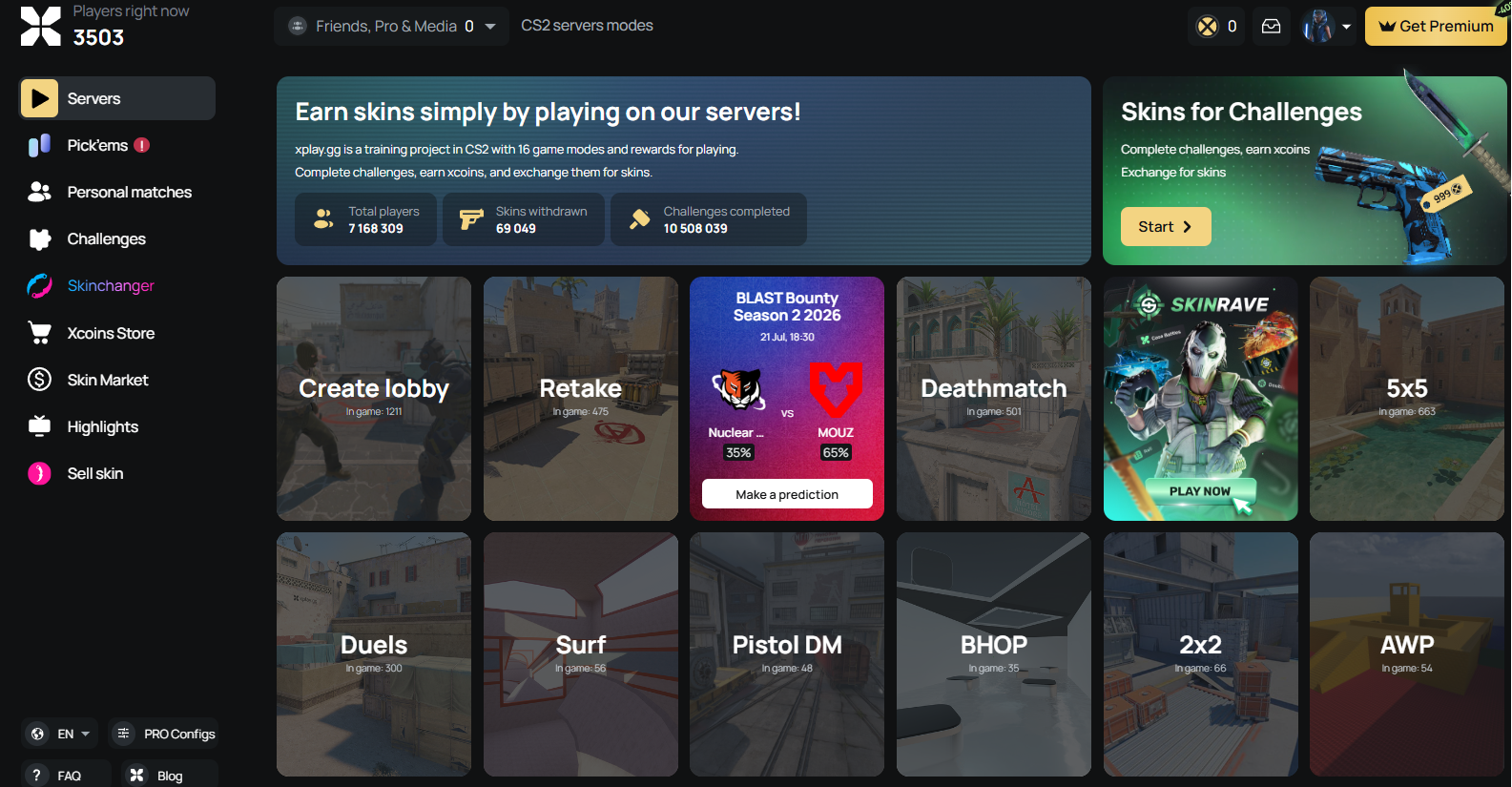
xplay.gg brings multiple warm-up modes together in one place, so you can choose by goal instead of searching through random community servers.
A Warm-Up Server Is Not the Same as a Training Session
A CS2 warmup server gets your mechanics ready for the next match. It helps you find your counter-strafe timing, lock in your crosshair placement, and clean up your first bullets before you queue. Training has a different purpose: it isolates one weakness and improves it through repeated reps over time.
Training often feels like nothing is changing. You run the same drills, miss the same shots, and start thinking you are wasting your time. That is normal. Progress is hard to notice from one session to the next.
Keep putting in focused reps, and you start noticing the difference in real rounds. Your crosshair arrives earlier, your bursts stay tighter, and common swings stop catching you unprepared.
For a pre-match warm-up, keep the session short and choose a server that matches the mechanic you need. Find your timing, land a few clean bursts, and leave before your reactions start slowing down. To understand when isolated drills are more useful than live fights, read Aim Maps vs Aim Servers: What Actually Improves Aim Faster in CS2?
Choose the Server by What Usually Loses You Rounds
Your warm-up mode should match the problem that shows up first in real matches.
Deathmatch: Best for Mechanical Activation
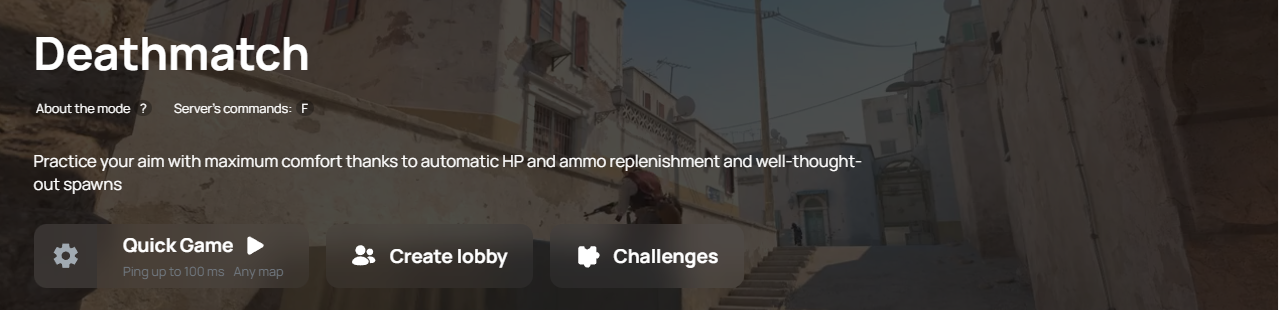
Classic Deathmatch is the best all-round option when your aim feels slow and you need to get several mechanics online at once. Fast respawns give you constant fights, so you can work on reactions, recoil rhythm, target switching, and movement under pressure.
Think about a T-side Mirage round where you swing out of Palace, kill the CT under Balcony, and immediately transfer onto the second player at Stairs. A DM warm-up prepares you for that kind of chained fight, where the first duel is only half the job.
Use DM with clear rules:
- hold your crosshair at likely head height;
- use taps at long range and short bursts at medium range;
- practice controlled sprays when the fight gets closer;
- reset after each kill instead of chasing the next sound.
DM loses value when you play only for the scoreboard. Constant wide swings, careless sprays, and running at every gunshot may earn more kills, but they build habits that rarely survive in real rounds.
HS DM and Pistol DM: Best for Precision Before You Queue
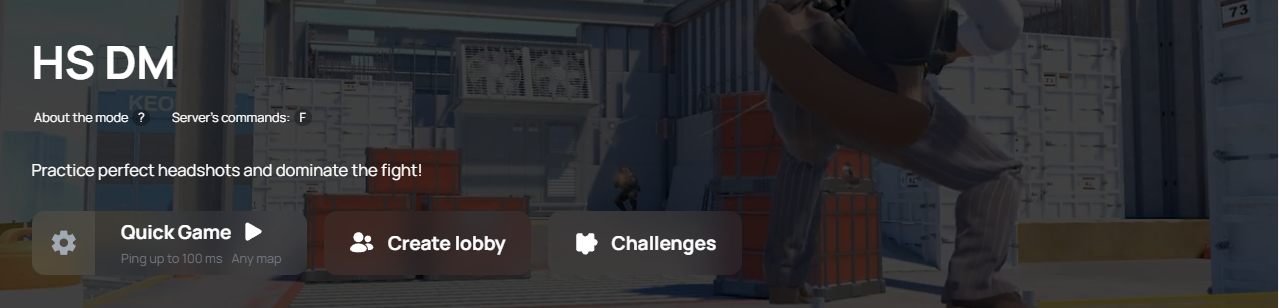
Join HS DM when your rifle aim starts dropping into the body. Since only headshots count, the mode punishes lazy crosshair placement and rushed counter-strafes. It's a good way to sharpen your first bullet before moving into regular rifle fights.
For a full comparison of the available Deathmatch formats, read HSDM vs Classic DM vs Pistol/AWP DM: Which Improves Faster?
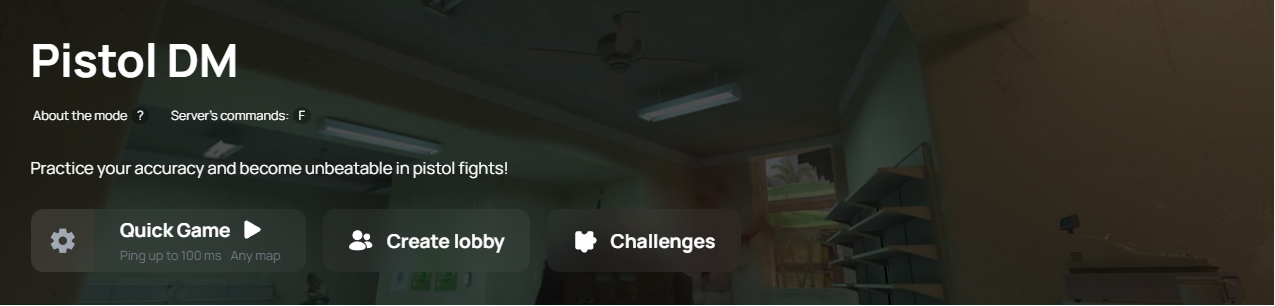
Pistol DM is more specific. It helps you rebuild confidence with the Glock-18 and USP-S, especially when you shoot too early, spam too fast, or lose accuracy while moving. A short Pistol DM training is useful before a session in which pistol rounds have been costing you early momentum.
Imagine a CT pistol round on Mirage. You are playing from Ticket and a T swings out from Tetris. You only have a small window to stop, place the crosshair, and land a clean USP shot before the trade arrives. HS DM prepares the head-level placement; Pistol DM prepares the weapon timing.
Consider HS DM for rifle precision and Pistol DM for pistol control. Once your first shot feels clean, move on.
AWP DM and Duels: Best When Your First Contact Must Be Sharp
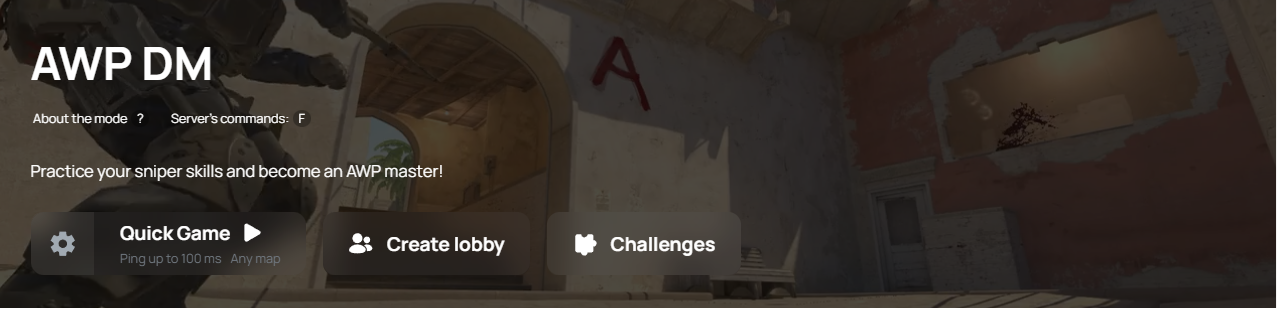
AWP DM is useful when your opening shot feels late or your scope timing is off. Use it to settle into common angles, hold tighter lines, and sharpen fast scoped reactions without turning every fight into a highlight-reel flick.
After the first shot, make a clear decision:
- hold the angle if you still have the advantage;
- fall back after one attempt if the trade is coming;
- avoid a predictable repeek when the opponent is already waiting;
- reposition when the same angle is no longer safe.
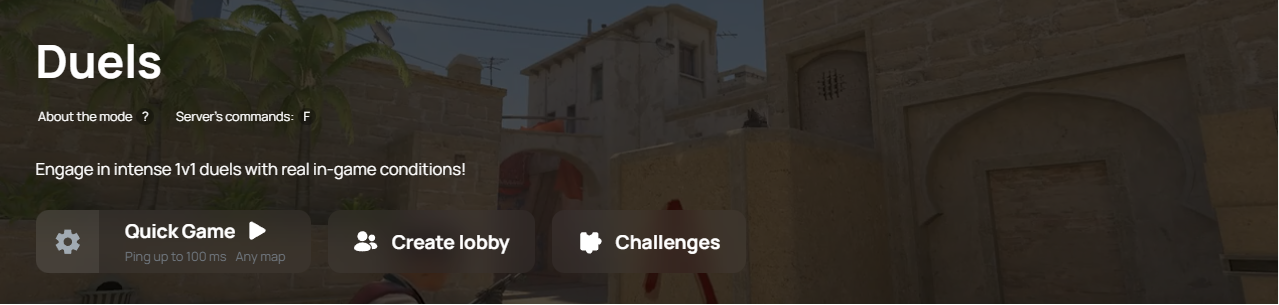
Go for Duels to add short, direct pressure. Repeated 1v1 fights force you to manage spacing, peek timing, and the immediate fight after contact instead of relying only on raw speed.
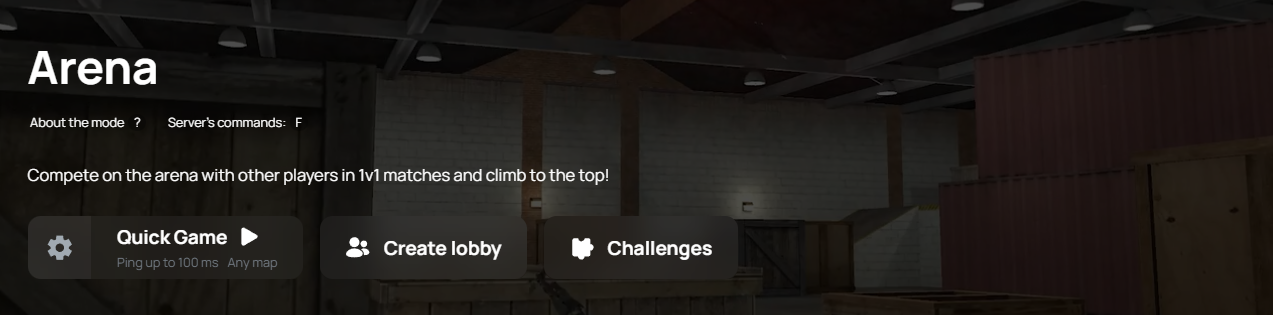
Arena serves a similar purpose but keeps you under repeated round pressure, making it a useful final training after your main mechanical warm-up.
Think about defending Mirage Window. You take the first shot toward Top Mid and miss. Now you must decide if you want to repeek, reposition toward Connector, or give up the angle. AWP DM sharpens the shot; Duels prepare you for the immediate fight that follows.
Retake: Best When You Need Match-Like Pressure
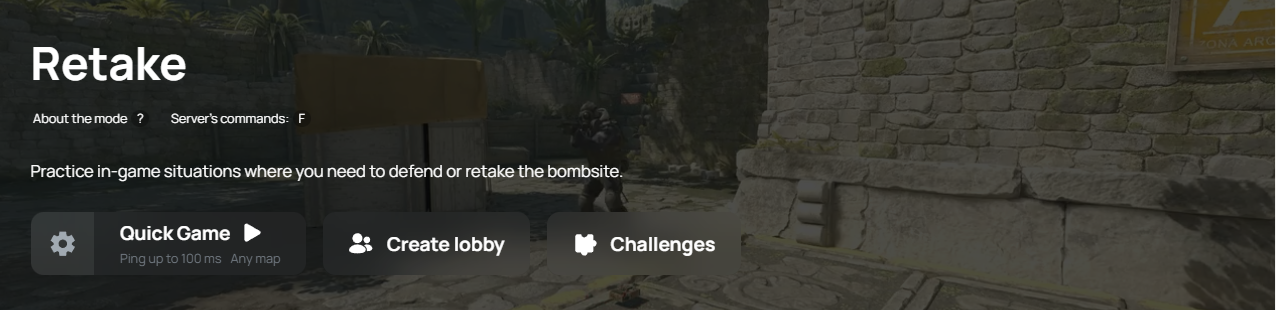
Use Retake when your aim feels fine but you still make poor decisions after the bomb goes down. Unlike DM, the mode forces you to play around utility, teammates, open angles, and the timer.
On CT side, focus on the site reclear:
- clear positions in order instead of swinging everything alone;
- use utility to force a T out of position;
- enter with your teammate and trade the first contact.
On T side, focus on the post-plant:
- hold a position that lets you play the bomb;
- delay the retake instead of chasing kills;
- avoid giving CTs separate 1v1 fights.
In a Mirage A retake with the bomb planted for Ramp, one T is on Tetris and the second is in Palace. Running straight onto the site gives both players separate fights. A better approach is to clear Palace with utility, pressure Tetris together, and keep enough time for the defuse.
Choose Retake before queueing when late-round pressure, not raw aim, is the part of your game that needs work. To improve your positioning and decision-making while holding a site, see How to Practice CT Anchor Positions in CS2.
The 10-Minute and 20-Minute Warm-Up Server Plans
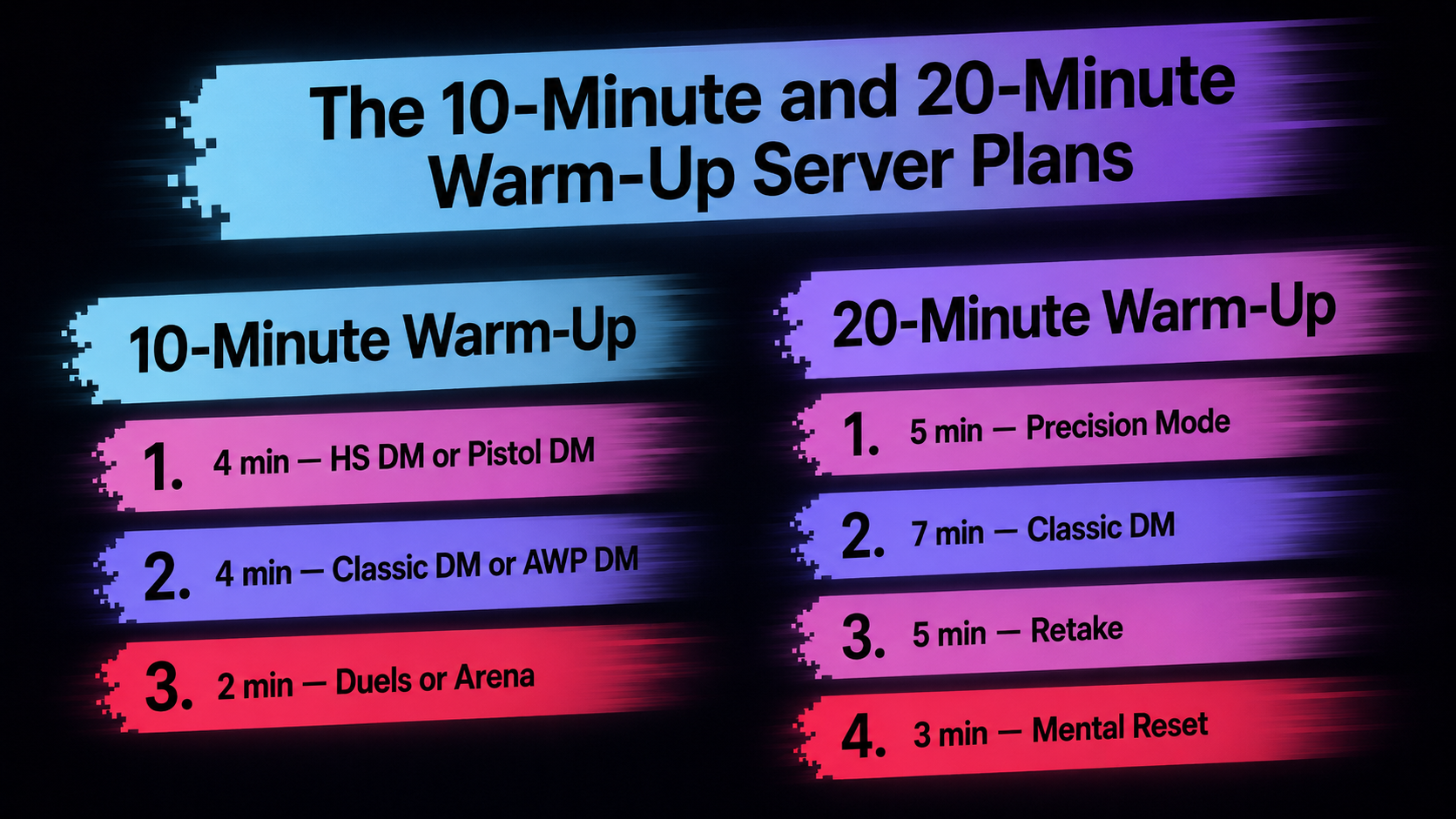
Use the 10-minute routine when you only need to get your mechanics online. Choose the 20-minute version when you also want a short transition into match situations.
10-Minute Warm-Up
- 4 minutes — HS DM or Pistol DM: choose based on the skill that feels less reliable.
- 4 minutes — Classic DM or AWP DM: switch according to your usual role.
- 2 minutes — Duels or Arena: finish with direct 1v1 pressure.
Move on as soon as each block ends. The routine should prepare you for the queue, not turn into a full practice session.
20-Minute Warm-Up
- 5 minutes — precision mode: start with HS DM or Pistol DM.
- 7 minutes — Classic DM: raise the pace and take more varied fights.
- 5 minutes — Retake: shift from isolated gunfights into round-based situations.
- 3 minutes — mental reset: leave the server, relax your hand, and clear your head before queueing.
For a complete routine built specifically around competitive matchmaking, see How to Warm Up for Premier in CS2 Without Wasting Your First Match
Use the reset to leave DM habits behind. Take your hand off the mouse, breathe, and decide what your first-round role is likely to be. That small pause helps you enter Premier or FACEIT ready to play the round instead of chasing the next fight.
Where xplay.gg Fits Into the Warm-Up Workflow
xplay.gg removes the need to search through separate community servers before every session. Deathmatch, HS DM, Pistol DM, AWP DM, Retake, Duels, and Arena are available through the same platform, so you can go directly to the mode already included in your routine.
This is especially useful when you only have 10 or 20 minutes before the queue. Instead of checking server names, tags, and settings, you can spend that time taking useful reps.
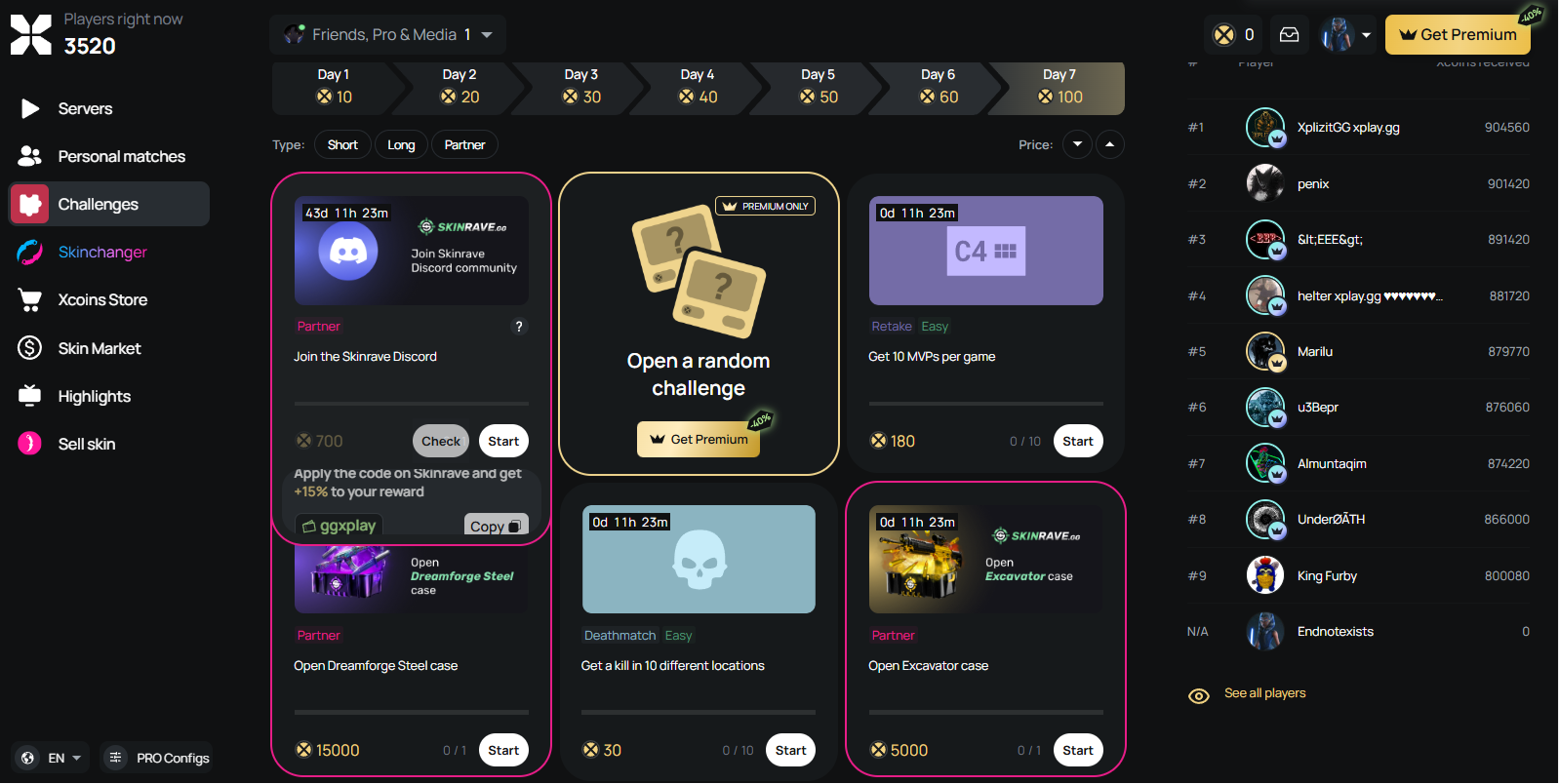
The xplay platform also connects server play with Challenges. When a Challenge matches the mode you already planned to use, you can complete it during the session and earn xcoins. Those xcoins can be spent on skins in the Xcoins Store or used in Auctions.
Challenges and xcoins add value to the time you already spend warming up, but the match goal should still decide which server you join.
Bottom Line: Leave the Server at the Right Time
A warm-up stops being useful once you begin forcing fights, chasing a clean final streak, or staying because one bad sequence annoyed you. At that point, you're no longer preparing for the match. You're reacting to the server.
Finish the session on schedule and take a short break before the queue. Relax your hand, reset your posture, and carry one clear intention into the opening rounds. That could mean holding your utility longer, avoiding an unnecessary repeek, or giving your teammate space to trade.
The goal is not to leave the server feeling unbeatable. It is to enter Premier or FACEIT calm enough to play the round instead of proving something in the first duel. Complete your planned block on xplay.gg, step away for a moment, and queue while your focus is still clear.